-
Jewish Studies 57 (2) (2022) Table of Contents Abstracts List of Articles: Noam Mizrahi - The Interpretive Transmission of Isaiah as Witnessed by 4QIsag (4Q61) Yael Escojido and Emmanuel Friedheim - The Liberation of Jewish Slaves in the Letter of Aristeas as an Expression of Fear of Assimilation: A Study of the Assimilation Process Affecting Jewish Slaves in the Hellenistic Diaspora Hananel Mack - Because of Whom do the Rains Fall? Alternating Credits in Rain Stories of the Aggadah Literature Gilad Sasson - “In the Sanctuary, O Lord, which thy Hands have Established”: The Homily of Mekhilta of R. Ishmael and Its Parallels in Avot de-Rabbi Natan and in Bavli Ketubbot
-
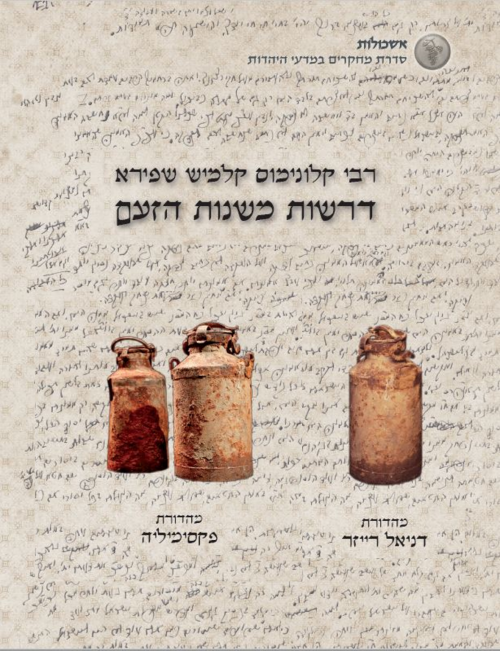
Sale!Scholarly and Facsimile Edition This book presents the sermons of Rabbi Kalonymus Kalmish Shapira, The Piaseczno Rebbe, which were delivered during the Holocaust years in the Warsaw Ghetto. The second volume is a facsimile edition, with the original manuscript on one side and the detailed line-by-line presentation of the text as the Rebbe corrected it. The second volume includes the words and passages that were deleted and is printed in 4 different colors which follow the proofs and changes that the Rebbe made in the text.
-
Jewish Studies 57 (1) (2022) Table of Contents Abstracts List of Articles: Maya Shemuelli- An Existential View of Return and Alienation: Exegetic Examination of the Book of Ruth Ofer Elior- The Medieval Hebrew Translations of Euclid's Elements Judith Weiss- Dehiyya, Halifa, and HIbbur: Sefirotic Notions of Metempsychosis in Early Kabbalistic Literature and Some of their Reverberations Ayelet Walfish-Fraenkel- Angels, Demons, and Warlocks: The Myth of the Sons of God and the Daughters of Men in the Zohar as an Etiology of Evil Neta Dan- “22 Letters for Cursing”: Swearing and Insults in Uri Zvi Greenberg's Poetic Language
-
Table of contents can be found in this link.
-
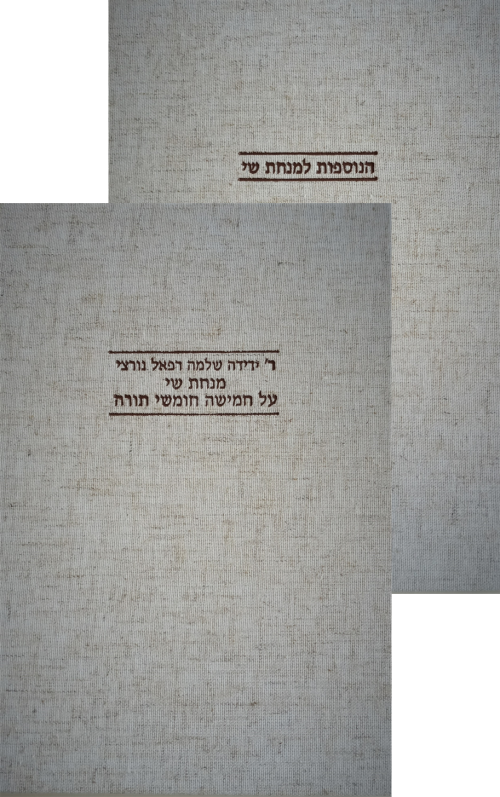
Sale!Minhat Shai, by the seventeenth-century scholar Yedidyah Shlomo Norzi, deals with the forms, vocalization, and Masoretic interpretation of biblical terms, in the order of their appearance in the Bible. The aim of this work is to analyze words with respect to their orthography, vocalization, and cantillation, and to assess their proper forms. The work was first printed in Mantua in the middle of the eighteenth century; it has since been reprinted in various places and always as part of editions of the Pentateuch or other sections of the Bible. The version in use today accords with the text as printed in Mikra’ot Gedolot (Vilna/Warsaw editions), where the relevant sections were appended following each biblical book. The Addenda to Minhat Shai complete the publication of Minhat Shai on the Torah.
-
The Addenda to Minhat Shai complete the publication of Minhat Shaion the Torah by Yedidyah Shlomo Norzi.
-
Meir of Rothenburg (c. 1215 – 2 May 1293) was a German Rabbi and poet, a major author of the tosafot on Rashi’s commentary on the Talmud. He is also known as Meir ben Baruch, the Maharam of Rothenburg. His responsa are of great importance to advanced students of the Talmud, as well as to students of Jewish life and customs of the 13th Century.
-
Meir of Rothenburg (c. 1215 – 2 May 1293) was a German Rabbi and poet, a major author of the tosafot on Rashi’s commentary on the Talmud. He is also known as Meir ben Baruch, the Maharam of Rothenburg. His responsa are of great importance to advanced students of the Talmud, as well as to students of Jewish life and customs of the 13th Century.
-
Sale!Jewish Studies 56 (2021) Full Table of Contents Abstracts List of Articles: HEBREW SECTION Yuval Fraenkel - Between Man and Place: The Holy Man and the Temple in Stories about Ḥoni Ha`meagel, and R. Ḥanina Ben Dosa Yosef Marcus - The Status of Persons with Physical Defects in Tannaitic Literature: A New Analysis Michael Avioz - “It is Known that the Stag eats Snakes”: Examining the Scientific Knowledge Drawn Upon by Medieval Jewish Interpretations of Psalms 42 Abraham David - Flavius Josephus’s Writings in Sixteenth Century Jewish Historiography: The Case of Shalshelet ha-Kabbalah of Gedalyah Ibn Yaḥya Chen Avizohar-Hagay and Yuval Harari - ‘For a Woman in a Hard Labor’: A Compilation of Magic Recipes to Deal with Labor Difficulties Ben Landau Spinoza and the “Ecole de Paris” 161 ENGLISH SECTION Israel Knohl - The Original Version of the Priestly Creation Account and the Religious Significance of the Number Eight in the Bible and in Early Jewish MysticismIn his influential study on Jewish mysticism, Gershom
-
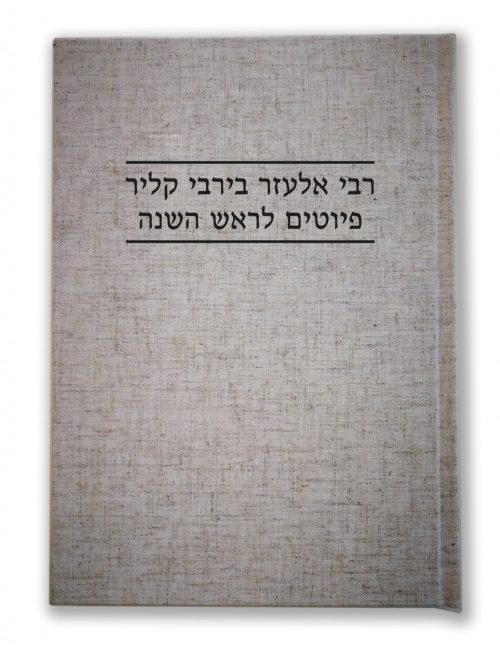
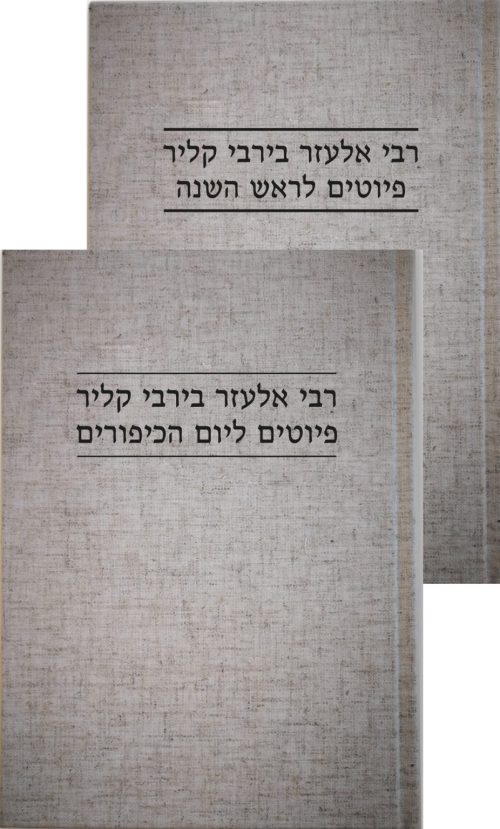
Sale!Rabbi El’azar Berabbi Qillir (commonly known as “HaQallir”) was the most famous and productive of the Hebrew poets during the peak era of early Hebrew piyyut (liturgical poetry) between the sixth and eighth centuries AD. Of the thousands of poems he penned, some were preserved in the Asheknazi, French and Italian mahzorim (prayer books) for the High Holy Days, and a few of them are recited in synagogues to this day.
-
Rabbi El'azar Berabbi Qillir (commonly known as "HaQallir") was the most famous and productive of the Hebrew poets during the peak era of early Hebrew piyyut (liturgical poetry) between the sixth and eighth centuries AD. Of the thousands of poems he penned, some were preserved in the Asheknazi, French and Italian mahzorim (prayer books) for the High Holy Days, and a few of them are recited in synagogues to this day. Notable examples of such from among his Yom Kippur poems are the poems "Praise God: Almighty, King of His universe" ("אמרו לאלהים: אל מלך בעולמו") and "The work of our God! He is mighty amidst His [Divine] assembly" ("מעשה אלהינו אדיר בוויעודו"); these two poems are still recited even in those Ashkenazi communities which skip most of the other poetic segments recorded in the mahzorim for the High Holy Days. The Cairo Geniza findings indicate that the European mahzorim preserve only a handful of Qillir's works for Yom Kippur. In fact, he adorned each of the day's prayers with several poetic compositions, most especially with qedushta'ot, arrays of poems intended to be recited as part of the amidah ("the standing prayer"), anticipating the recitation of the qedusha. Time and again, Qillir penned new compositions intended to replace the previous ones. Alongside his qedushta'ot for musaf and for ne'ila which are found in the Ashkenazi mahzorim, the Genizah fragments reveal additional Qillirian qedushta'ot for these same prayers, as well as poems for ma'ariv, shaharit and minha. In addition, it turns out that the qedushta'ot in the Asheknazi mahzorim were corrupted; some of the original Qillirian segments were omitted, and later non-Qillirian segments were interpolated at various places. The present edition comprises a collection of all of the surviving poems authored by Rabbi El'azar BeRabbi Qillir for all of the Yom Kippur prayers. This edition attempts to restore the full compositions as per the textual witnesses from the Cairo Genizah, with the aid of the material from the European mahzorim. The poems are printed with full vocalization, apparatus criticus, and extensive running commentary. The restoration of the qedushta'ot incurred many questions, discussed in detail in the introduction. The introduction includes a comprehensive exploration of the multiple segments contained in each of Qillir’s compositions, including a discussion of the exact purpose of each segment and a justification of its attribution to Qillir. The introduction also describes the prosodic structures of Qillir’s poems for Yom Kippur, their poetic characteristics, their unique language and stylistics, and their thematic content. An additional section focuses upon rare midrashic traditions reflected within the poems, as well as rare Jewish legal traditions and customs. Many of the poetic segments contained herein have never before appeared in a proper scientific edition, including spectacular works such as silluq (the segment immediately prior to the qedusha) for musaf; a series of rahitim (poems prior to the silluq) expounding upon the verses describing the High Priest's work on Yom Kippur, and another series of over twenty rahitim praising God, which are without a doubt among Rabbi El'azar BeRabbi Qillir's finest works; and sidre pesukim (poetic compositions which expound upon the Biblical verses which were recited during that era within the amidah itself). In his compositions for the minha prayer, Qillir often dedicates the rahitim to the story of Elijah the Prophet on Mount Carmel; several of these describe the miracle of the fire coming down from the sky, and primarily Elijah's prayer – which in effect becomes the poet's prayer for his audience. Perusal of the poems reveals quite a few surprises, from original linguistic feats to previously unknown Midrash traditions, and above all, uplifting segments of poetry. Several of these are presented in the introduction, but the edition is the crux of the book, and through it readers will be able to delve deep into Qillir's Yom Kippur poems, to learn from the Torah contained within them, and to delight in their beauty.