-
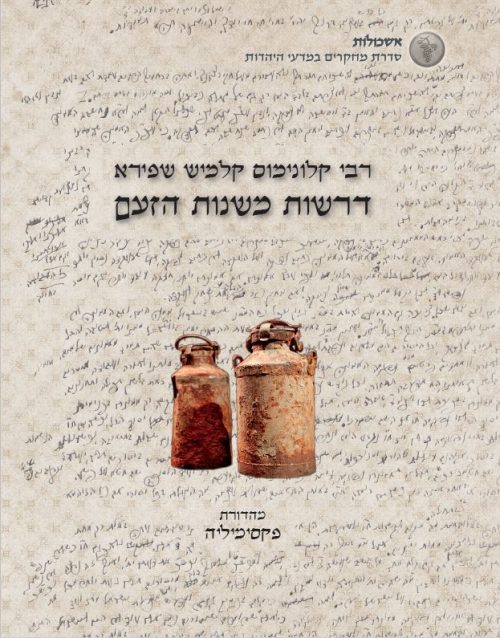
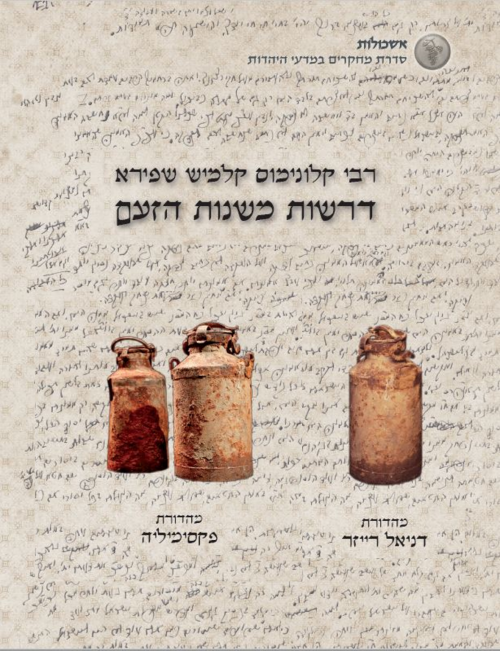
Sale!Facsimile Edition This book presents the sermons of Rabbi Kalonymus Kalmish Shapira, The Piaseczno Rebbe, which were delivered during the Holocaust years in the Warsaw Ghetto. The second volume is a facsimile edition, with the original manuscript on one side and the detailed line-by-line presentation of the text as the Rebbe corrected it. The second volume includes the words and passages that were deleted and is printed in 4 different colors which follow the proofs and changes that the Rebbe made in the text.
-
Sale!Jewish Studies 55 (2020) Full Table of Contents Abstracts List of Articles: Michael Schneider z"l - The Liturgical Roots of the Kabbalistic Concept of ‟Unification” Eliyahu Rosenfeld - “One Must Speak with Silence”: The Function of Silence in Virginity Claim Stories from the Babylonian Talmud Richard Hidary - The Talmud as Rhetorical Exercise: Progymnasmata and Controversiae in Rabbinic Literature Eli Gurfinkel - The Order and Structure of the List of the Maimonidean Principles: Between Form and Meaning Hagay Shtamler - “The Course of Ideas in Israel” as a Response to Wissenschaft des Judentums” Book Reviews: Uziel Fuchs - Review of Yaacov Sussmann, Oral Law Taken Literally: The Power of the Tip of a Yod, Jerusalem: Magnes, 2019 Tamar Kadari - Review of Marc Hirshman, Midrash Kohelet Rabbah 1-6: A Critical Edition, Jerusalem: Schechter Institute of Jewish Studies, 2016
-
Sale!Jewish Studies 56 (2021) Full Table of Contents Abstracts List of Articles: HEBREW SECTION Yuval Fraenkel - Between Man and Place: The Holy Man and the Temple in Stories about Ḥoni Ha`meagel, and R. Ḥanina Ben Dosa Yosef Marcus - The Status of Persons with Physical Defects in Tannaitic Literature: A New Analysis Michael Avioz - “It is Known that the Stag eats Snakes”: Examining the Scientific Knowledge Drawn Upon by Medieval Jewish Interpretations of Psalms 42 Abraham David - Flavius Josephus’s Writings in Sixteenth Century Jewish Historiography: The Case of Shalshelet ha-Kabbalah of Gedalyah Ibn Yaḥya Chen Avizohar-Hagay and Yuval Harari - ‘For a Woman in a Hard Labor’: A Compilation of Magic Recipes to Deal with Labor Difficulties Ben Landau Spinoza and the “Ecole de Paris” 161 ENGLISH SECTION Israel Knohl - The Original Version of the Priestly Creation Account and the Religious Significance of the Number Eight in the Bible and in Early Jewish MysticismIn his influential study on Jewish mysticism, Gershom
-
Jewish Studies 57 (1) (2022) Table of Contents Abstracts List of Articles: Maya Shemuelli- An Existential View of Return and Alienation: Exegetic Examination of the Book of Ruth Ofer Elior- The Medieval Hebrew Translations of Euclid's Elements Judith Weiss- Dehiyya, Halifa, and HIbbur: Sefirotic Notions of Metempsychosis in Early Kabbalistic Literature and Some of their Reverberations Ayelet Walfish-Fraenkel- Angels, Demons, and Warlocks: The Myth of the Sons of God and the Daughters of Men in the Zohar as an Etiology of Evil Neta Dan- “22 Letters for Cursing”: Swearing and Insults in Uri Zvi Greenberg's Poetic Language
-
Jewish Studies 57 (2) (2022) Table of Contents Abstracts List of Articles: Noam Mizrahi - The Interpretive Transmission of Isaiah as Witnessed by 4QIsag (4Q61) Yael Escojido and Emmanuel Friedheim - The Liberation of Jewish Slaves in the Letter of Aristeas as an Expression of Fear of Assimilation: A Study of the Assimilation Process Affecting Jewish Slaves in the Hellenistic Diaspora Hananel Mack - Because of Whom do the Rains Fall? Alternating Credits in Rain Stories of the Aggadah Literature Gilad Sasson - “In the Sanctuary, O Lord, which thy Hands have Established”: The Homily of Mekhilta of R. Ishmael and Its Parallels in Avot de-Rabbi Natan and in Bavli Ketubbot
-
Critical annotated edition of part one of treatise seven of R. Levi's encyclopedia, which is devoted to an exegesis of the "Work of the Chariot". This volume also contains an edition of the surviving section of treatise five of the encyclopedia ("Divine Science") and a critical edition of the section of the poem "Battei ha-Nefesh ve-ha-Laḥashim" devoted to the "Work of the Chariot", together with the four medieval commentaries written on this section. The introduction to this volume discusses at length the interpretation of the "Work of the Chariot" from rabbinic times to R. Levi. Towards the end of the thirteenth century, the Provençal Jewish philosopher R. Levi ben Avraham wrote a unique treatise – an in-depth Hebrew encyclopedia of the sciences and of Judaism entitled Livyat Ḥen. R. Levi was known already in his lifetime as a leading exponent of the philosophical-allegorical interpretation of the Torah and of rabbinic midrash. In the Jewish part of his encyclopedia he deals with a myriad of topics, including Jewish ethics, prophecy, the reasons for the commandments, the stories of Moses and the patriarchs, the principles of faith, the Work of Creation, the Work of the Chariot, and the interpretation of rabbinic midrash and aggadah. Prior to Livyat Ḥen R. Levi wrote an encyclopedic poem of over 1000 stanzas in rhymed meter entitled Batei ha-Nephesh ve-ha-Laḥashim. This poem is devoted to the same topics in science and Judaism that are later discussed in great detail in his treatise.
-
Rashi was the first Biblical Commentator in Northern France (Ashkenaz) to compose a comprehensive commentary to the Book of Proverbs, and this commentary has survived in 55 manuscripts scattered in libraries throughout the world. For the first time we present a critical edition of this commentary to Proverbs. This critical edition is based on MS New York JTS Lutzki 778. Variant readings from six other accurate manuscripts, the two earliest printed editions, and three later printed editions appear in the apparatus of variants. The edition also contains a “super-commentary” in which difficult words & sections in need of clarification are explained. The editor searched for Rashi’s sources - both those explicitly stated and those not. Preceding the critical edition is an introduction which analyzes important topics such as: interpolations to the commentary, Rashi’s exegetical approach, language & syntax and the Jewish-Christian debate.
-
The book Ahava ba-Taanugim (Love In delights) was written during the years 1353 – 1356 by Rabbi Moses Ben Judah. It is a huge and comprehensive encyclopedia of Aristotelian physics and metaphysics and includes also a substantial theological section. Its author discusses and explains each scientific topic in a creative and innovative way: Some explanations on matter, atoms, time and motion, have no source in the classical Aristotelian literature. These innovations contributed to the development of sciences of the author's days and they reflect new trends of the study of Aristotle's philosophy of nature among the 14th century scholars. These trends paved the ground for modern science that, as modern scholarship observed, did not emerge ex nihilo, but had its roots in the criticism of Aristotelian science in the 14th century. The current book is a critical edition of the first seven discourses of the first part of the encyclopedia, which deals with physics. Each discourse deals with one scientific topic and includes some biblical commentarial chapters that aim to show the harmony between the scientific topic and the Torah and to expose the secrets that were hinted by Ibn Ezra, Maimonides and Nachmanides in their treatises. The edition includes an introduction which presents a general overview of the treatise: its period, place and its purpose, its sources and its approach. The introduction also describes and explains the content of the seven discourses presented in the edition and highlights its innovations and main original explanations. This book is in Hebrew edition only.
-
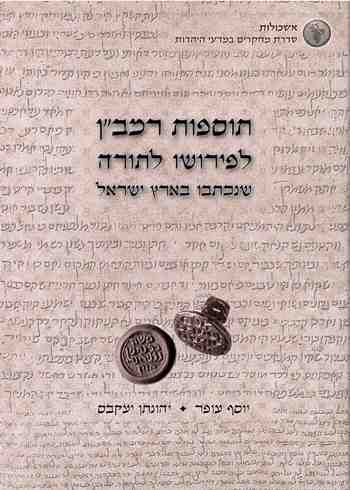
This book presents three hundred pieces added by Rabbi Moshe ben Nachman (Nachmanides) to his commentary on the Torah when he made Aliyah to Israel at the end of his life. The added segments were identified according to update lists sent by Nachmanides himself and others to the Diaspora, as well as on the basis of extensive comparative examination of all the hand-written transcripts of Nachmanides' interpretation of the Torah found today in the world (about fifty in number). There is a comprehensive introduction at the beginning of the book, that discusses the phenomenon of the additions and analyzes the findings of the hand-written transcripts and surveys the reasons and for these additional pieces. The bulk of the book is comprised of interpretive discussions detailed in every piece; whose purpose is to clarify Nachmanides' motives when making additions to what he first wrote. In the book itself – and the website that accompanies it – detailed information is presented about the additions and the evidence of them in the list of additions and the hand-written transcripts. The awareness of the commentary's formation by those who studied the commentary, both at large and specifically for each particular piece, adds a new dimension to the commentary, and is a significant contribution to understanding the way of Nachmanides, to solving problems in his sayings and clarifying his intent. To this end, the book is a very important tool for scholars of Nachmanides, Torah learners and lovers.
-
Critical annotated edition of the third part of treatise six of R. Levi's encyclopedia, which is devoted to an exegesis of the "Work of Creation". In this part R. Levi deals with the creation story in the Torah, the story of Adam and Eve in the Garden of Eden, and the stories of the early generations of humanity. The edition includes both the shorter and longer recensions of this part, as well as a critical edition of the section "Work of Creation" in R. Levi's encyclopedic poem, "Battei ha-Nefesh ve-ha-Laḥashim", together with the four medieval commentaries written on this section. The introduction to this volume discusses the author and his works and deals with the historical background to R. Levi's approach to the "Work of Creation".
-
Along with the official Aramaic translation of the Prophets, known as "Targum Yonatan", other Aramaic translations were circulating in the Jewish communities. These translations, most of which are found in manuscripts, are referred to in the modern research as "Translation Supplements" (Toseftot Targum), some of which have Midrashic extensions. The source of the translation additions is vague: they may be part of a complete Palestinian translation of the prophets, and they may be translations of the Haftoroh chapters only. The book contains a collection of one hundred and fifty texts, with a varied dialectical nature collected from over a hundred manuscripts and first editions.
-
This commentary was first published in 1855 in the Aharon Yelink Edition of the 32 Hamburg manuscripts and was welcomed happily by the Jewish Sages of that generation, however it was quickly forgotten and its relation to Rashbam was distrusted. The damaged edition, in which it was published, did not benefit it either, and it hardly left any impression on the Biblical research of the new age. The current essay is a revised scientific edition of the commentary, based on all the known wording testimonies known today: Three complete manuscripts, two segments of other manuscripts and another written testimony of another manuscript which we do not hold. The commentary's edition is preceded by a comprehensive preface which deals with a wide range of subjects: identifying the commentary's author, its affinity to other essays by Rashbam, the sources of the commentary, the literary aspects of the commentary, allegoric commentary of Song of Songs and his message according to his time and era, verbal issues in the commentary and an introduction to this edition.
-
Sale!A qedushta is a series of piyyutim for the ‘Amida prayer, which is expanded in honor of the recitation of the Qedusha, and includes many complex components. Its origins are in the Land of Israel, in the fourth or fifth century. We first see it as a constructed composition with set, complex, rules in the work of the poet Yannai, who lived in the mid-sixth century, the teacher of Rabbi El‛azar berabbi Qillir (who is known popularly as “the Qallir”). The qedushta, as it appears in the hundreds of compositions by Yannai and his followers, conceals many secrets: mysterious strings of biblical verses accompany its first components; a fixed biblical verse concludes the third component, followed by the strange words “El Na”; then comes a fourth component, whose structure is free, and always concludes, for some reason, with the word “Qadosh”; the fifth component in Yannai’s compositions is the ‘asiriya, a poem constructed of a truncated alphabetical acrostic from only aleph to yud, followed by a prayer beginning “El Na Le‘olam Tu‘aratz” – and it is unclear why this prayer appears here; then there is a group of poems called rahitim, which are written, for some reason, in unique, stereotypical structures. These are only a fraction of the various strange features of the qedushta’ot of Yannai and the other poets. The discussions in the book are dedicated to suggesting solutions to all these questions, and to others, and involve uncovering fragments of qedushta’ot that preceded Yannai; by examining these texts, they excavate the literary remains to construct a model of the gradual development of the qedushta over time, from its origins until it reached its complex structure in the days of Yannai and Rabbi El‛azar berabbi Qillir. The first section of the book, which is the largest, is devoted to this development of the qedushta, in all its elements, including those that follow the recitation of Qedusha. Naturally, this section deals with the piyyutim mostly from a structural point of view, for only such an analysis can enable a comprehensive look at the development of the genre. However, as a base for these structural analyses, this section contains the texts of many piyyutim, mostly pre-classical (from the period before Yannai, when the poets did not yet use rhyme). Alongside them are printed classical rhyming piyyutim, too, from the period of Yannai and his colleagues, and, in a few instances, even piyyutim from later periods. The second section of the book focuses on one single poet: Rabbi El‛azar berabbi Qillir, the most prolific of the classical poets in the Land of Israel, whose poems reached Europe, and some of them are recited in Ashkenazic and Italian synagogues through today. The qedushta’ot of Rabbi El‛azar berabbi Qillir are varied in both their structures and their styles, much more than those of Yannai; this section is devoted to an analysis of these compositions, and an attempt to map out which ones are earlier and which later. On the basis of precise structural analysis, the section builds a higher level of analysis – stylistic; and thus, we see the picture of the great poet’s literary journey. It becomes clear that when he was started out, he was heavily influenced by the work of Yannai, and slowly he created new ways for himself: at first he went in the direction of obscurity and difficulty, which he gradually made more and more obscure; but then, in a later, more mature phase, he turned to pure lyrical song, which today’s reader, too, will find sweet. The third section leaves aside the structural analyses, and suggests directions for further research. This section is short, and contains only first steps towards new directions in piyyut analysis. It focuses primarily on content, and ways that the qedushta’ot are organized, but it moves on to questions of how the qedushta is constructed as a complete composition, and points out various difficulties that the poets needed to overcome, and analyzes at length their literary solutions to these problems. Yannai stands at the center of the discussion in this section, but there are also notes about other poets. Most of the suggested directions for further research are new, and we hope that they will lead to further productive scholarship, and make it possible to study the piyyutim from angles that have hitherto been less examined. Throughout the book, phenomena are demonstrated by means of the texts of piyyutim. More than 250 piyyutim are printed in the book, of which about 130 are being printed for the first time. Most of these piyyutim are from the earlier periods of piyyut, and their publication in this volume reveals the full contribution of these layers of the genre to our understanding of the history of the qedushta. Even the piyyutim that have already been printed elsewhere often were published in out-of-the-way publications, some of them with no vowels or commentary. It goes without saying that for this volume, these texts were all printed anew straight from the manuscripts. When pieces from Yannai’s work are cited to exemplify some point, an attempt has been made, inasmuch as possible, to use pieces that have not been included in the existing publications of his work, and thus the volume contributes a great amount of new material to the corpus of Yannai’s piyyutim. The volume as a whole is based on examination of hundreds of manuscripts, mostly from the Cairo Geniza, and these provide a wide, firm textual basis to the analysis. The book is intended first and foremost for scholars, but it will also enable people interested in piyyut and its history from outside the world of academia to gain exposure to a great corpus of early piyyutim, among which are several stunningly beautiful gems, which are being published here for the first time.
-
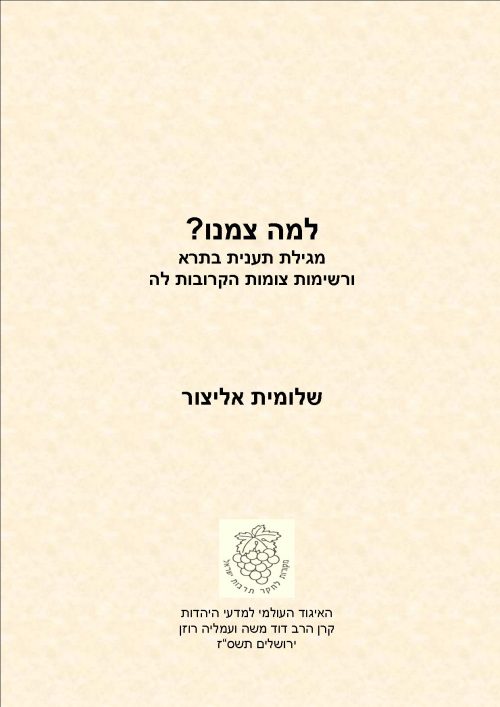
For over fourteen hundred years, since post-Talmudic times, a list of fast days has been in circulation; it mandates at least one, but occasionally two, three, and even four fasts per month. These fasts commemorate disasters that occurred during biblical and Second Temple times; events connected with the Temple’s destruction; and the deaths of well-known individuals. The list penetrated into central halachic works; in some circles these events are commemorated to this day, albeit not by fasting. This list is known as Megillat Taʿanit Batra, “the later scroll of fasts,” to distinguish it from Megillat Taʿanit, which originated in the Second Temple period. This book traces the historical development of the list. The author has culled previously unknown versions of this list from manuscripts, early piyyutim, and other surprising sources. All these versions of the list are discussed in detail; a synoptic analysis of each fast, as presented in the various sources, attempts to solve some of the riddles presented by the texts. Towards the end of the book, a detailed chapter deals with the complex occurrences of the list in halachic literature. The final chapter sets out the internal structure of the list; attempts to arrive at its original form; and maps its metamorphoses through time.
-
This book represents a first attempt to assemble liturgical poems in a scientific edition according to their genre rather than according to authorship. All the Shiv‛atot cycles (liturgical poems for shabbat Amidah prayer) composed according to the order of the weekly Torah portion have been collected from the Genizah manuscripts. The book presents three main cycles, representing three stages in the history of liturgical poems: The remnants of an ancient Shiv‛atot cycle (composed around the sixth century) which was dedicated to the reading order of the Eretz-Israel triennial cycle, and two Shiv‛atot cycles for the annual cycle’s tractates – one of which was probably composed around the ninth or tenth century and remains loyal to the classical traditions of the genre, and the second, probably composed at the end of the tenth century or the beginning of the eleventh, which reflects a stage in which the later poets abandoned the ancient patterns or restricted them. Alongside these cycles, sections of other Shiv‛atot cycles whose remnants were found in the Genizah are included. The poems are printed in their entirety, with variant manuscripts readings and detailed notes. The book opens with an introduction that describes each cycle in detail and examines the development of the genre over the generations.
-
Sale!Scholarly and Facsimile Edition This book presents the sermons of Rabbi Kalonymus Kalmish Shapira, The Piaseczno Rebbe, which were delivered during the Holocaust years in the Warsaw Ghetto. The second volume is a facsimile edition, with the original manuscript on one side and the detailed line-by-line presentation of the text as the Rebbe corrected it. The second volume includes the words and passages that were deleted and is printed in 4 different colors which follow the proofs and changes that the Rebbe made in the text.
-
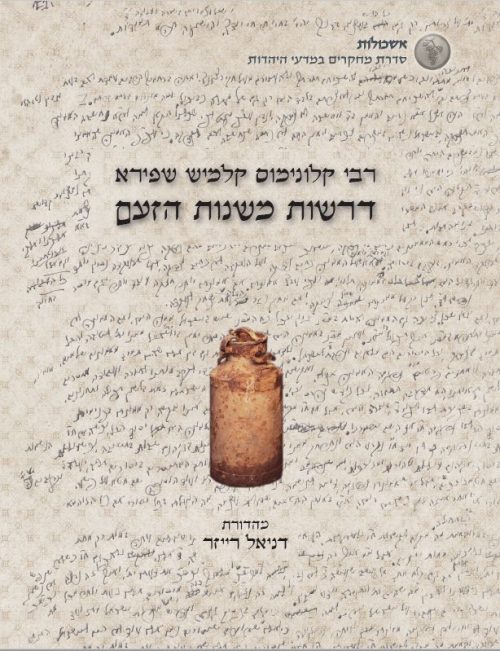
Scholarly Edition This book presents the sermons of Rabbi Kalonymus Kalmish Shapira, The Piaseczno Rebbe, which were delivered during the Holocaust years in the Warsaw Ghetto. The second volume is a facsimile edition, with the original manuscript on one side and the detailed line-by-line presentation of the text as the Rebbe corrected it. The second volume includes the words and passages that were deleted and is printed in 4 different colors which follow the proofs and changes that the Rebbe made in the text.
-
Table of contents can be found in this link.
-
For many years, Zunz’s study, originally published in 1859, served as a fundamental textbook for research on the history of prayer .This contemporary Hebrew translation includes research updates, many clarifications, and detailed indexes; among them an index of prayers, an index of prayer customs, an index of liturgical poetry, and an index of early manuscripts and printings of the prayer books mentioned in the study. In addition, the Hebrew edition includes notes and additions found on the author's personal copy, never to have been published before.
-
The commentaries of Midrash Chachamim were written by an anonymous Italian author in the early sixteenth century as part of an extensive commentary to the weekly portions of the Torah reading. Throughout the work, the author copied the early complete midrashim such as Genesis Rabba and the halakhic midrashim almost verbatim. His autonomous creation is contained mostly in the commentaries to those portions that are missing in the halakhic midrash, and as such they are contained in the books of Exodus, Numbers and Deuteronomy (though not for all portions of these books). The author tried to explain the verses according to their plain meaning, although he often incorporated in-depth discussions as well as interpretive and pedagogic excursus. In this edition, for the first time, the commentaries of Midrash Chachamim were collated from manuscript for the 27 weekly portions for which they were written, and brought together in order to present the author’s hermeneutical approach. The edition is complemented with an introduction that shows the background for writing these commentaries and discusses the style and interpretive techniques employed by the author.
-
The Babylonian Talmud is the fundamental work of the Oral Law, both by virtue of the widespread and intensive study of it, and by virtue of reliance on it in halakhic writings, for over a thousand years. The Talmud gained much of its importance during the Geonic period. Throughout this time its transmission shifted from oral recitation to written copies, its text became standardized, and it was sent out from the Babylonian academies across the Jewish diaspora. Its intensive study and complex system of transmission both orally and in writing resulted in many variant readings between extant copies. This book deals with questions concerning the ways in which the Babylonian Talmud became such as seminal work, and especially the Geonate’s treatment of the its textual tradition: the ways in which the Geonim related to the variant readings, how they chose between them, and according to what criteria; to what extent were its early readings preserved and to what extent was its text altered. In the second half of the book the entire corpus in which the Geonim deal with Talmudic variants is presented and discussed.
-
This book presents Piyyutim (liturgical poetry) written by one of the most important poets in the Land of Israel, Rabbi Pinhas Hacohen birabi Yaacov, who lived in the area of Tiberias in the 8th century. The Piyyutim are taken from manuscripts of the Cairo Genizah, and are published for the first time. R' Pinhas seals the classic period of early Paytanim (authors of liturgical poetry) in the Land of Israel. His work preserves the variety of genres typical for classic Piyyutim, yet shows early signs of developments characteristic to late Eastern liturgical poetry. R. Pinhas' Piyyutim reveal a great poet with impressive compositional durability. In some of them he reaches unique climaxes, especially through dramatic developments in the Piyut.
-
Out of stockMoreh Ha-moreh (The Guide’s Guide), by Shem-Tob ibn Falaquera, is one of the earliest commentaries on Maimonides’s Guide of the Perplexed. Falaquera’s knowledge of Arabic literature was broad, and he commented extensively on the well-known translation of the Guide by R. Samuel ibn Tibon. Given this knowledge, Falaquera was also acquainted with the philosophical sources behind Maimonides’ work, and referred to these in his own commentary. This critical edition of Falaquera’s work is based on all extant manuscripts known to us today; and it will be of value to all who wish to understand this important commentary and recover Maimonides’s sources. This edition presents the text of the Guide’s Guide, including varia lectionis and a commentary on Falaquera’s sources. These sources, which are largely also the sources of Maimonides, are discussed in great detail in the introduction to this edition.
-
Minhat Shai, by the seventeenth-century scholar Yedidyah Shlomo Norzi, deals with the forms, vocalization, and Masoretic interpretation of biblical terms, in the order of their appearance in the Bible. The aim of this work is to analyze words with respect to their orthography, vocalization, and cantillation, and to assess their proper forms. The work was first printed in Mantua in the middle of the eighteenth century; it has since been reprinted in various places and always as part of editions of the Pentateuch or other sections of the Bible. The version in use today accords with the text as printed in Mikra’ot Gedolot (Vilna/Warsaw editions), where the relevant sections were appended following each biblical book. Even today, the work is considered an important guide as far as the biblical text is concerned; it reflects important decisions on questions of biblical orthography and interpretation. Scholars and students refer to it and respect its verdicts even though the version currently in use contains numerous errata. Many of the vocalization and cantillation marks noted by the author have been altered or omitted; thus, the author’s arguments are at times unclear, and at times even seem to contradict what may have been his original intention.
-
The Addenda to Minhat Shai complete the publication of Minhat Shaion the Torah by Yedidyah Shlomo Norzi.
-
Sale!Minhat Shai, by the seventeenth-century scholar Yedidyah Shlomo Norzi, deals with the forms, vocalization, and Masoretic interpretation of biblical terms, in the order of their appearance in the Bible. The aim of this work is to analyze words with respect to their orthography, vocalization, and cantillation, and to assess their proper forms. The work was first printed in Mantua in the middle of the eighteenth century; it has since been reprinted in various places and always as part of editions of the Pentateuch or other sections of the Bible. The version in use today accords with the text as printed in Mikra’ot Gedolot (Vilna/Warsaw editions), where the relevant sections were appended following each biblical book. The Addenda to Minhat Shai complete the publication of Minhat Shai on the Torah.
-
Iggud - Selected Essays in Jewish Studies, Vol. 1 The Bible and Its World, Rabbinic Literature and Jewish Thought Editors: Baruch J. Schwartz, Aharon Shemesh, and Abraham Melamed Full Table of Contents Iggud: Selected Essays in Jewish Studies: Articles published in the Iggud Volumes will be based on the best lectures which were given in the World Congress for Jewish Studies held in Jerusalem once every 4 years, and these volumes will therefore replace the Proceedings of the World Congress of Jewish Studies which have been published thus far. In the first volumes of Iggud (1-3) were gathered articles based on lectures given on the 14th Congress held in August 2005. " In the Bible and Its World Section eleven articles are published in Hebrew and five in English. This large number reflects truthfully the strenuous development in researching Bible commentators and their methods, a subject which is again central in Biblical Science of this era. Beside articles in this field, appears a selection of articles about Bible Study itself with its various spheres, such as Biblical criticism and prophetic books, archeology and realism, and the various ways that Biblical Literature takes. The Rabbinic Literature and Jewish Law section includes nine Articles in Hebrew and two in English. These studies span several branches of Talmud and Halakha, and show especially the expanding interest, these days, in the questions touching on the process of editing and forming of Rabbinic Literature. Further to these studies dealing with these aspects of the profession, appear discussions in issues of Halakha, Law and Talmudic tale history. Eight articles in Hebrew and two in English are published in the Third section, which is dedicated to Jewish Thought. The studies are naturally divided into studies of contemplation and teachings of the philosophers themselves, through their writings together with the era they lived in and the elements influencing them on the one hand, and in these several studies comparing between the first and the last and studying the connection between them, and studying their methods of research on the other hand." (from the preface).
-
Iggud - Selected Essays in Jewish Studies, Vol. 2 History of the Jewish People and Contemporary Jewish Society Editors: Gershon C. Bacon, Albert Baumgarten, Jacob Barnai, Haim Waxman, and Israel Yuval Full Table of Contents Iggud: Selected Essays in Jewish Studies: Articles published in the Iggud Volumes will be based on the best lectures which were given in the World Congress for Jewish Studies held in Jerusalem once every 4 years, and these volumes will therefore replace the Proceedings of the World Congress of Jewish Studies which have been published thus far. In the first volumes of Iggud (1-3) were gathered articles based on lectures given on the 14th Congress held in August 2005.
-
Iggud - Selected Essays in Jewish Studies, Vol. 3 Languages, Literatures, Arts Editors: Tamar Alexander-Frizer, Yosef Tobi, Dan Laor, Ora Schwartwald, and Ziva Amishai-Maisels Full Table of Contents Iggud: Selected Essays in Jewish Studies: Articles published in the Iggud Volumes will be based on the best lectures which were given in the World Congress for Jewish Studies held in Jerusalem once every 4 years, and these volumes will therefore replace the Proceedings of the World Congress of Jewish Studies which have been published thus far. In the first volumes of Iggud (1-3) were gathered articles based on lectures given on the 14th Congress held in August 2005.
-
Sale!Meir of Rothenburg (c. 1215 – 2 May 1293) was a German Rabbi and poet, a major author of the tosafot on Rashi's commentary on the Talmud. He is also known as Meir ben Baruch, the Maharam of Rothenburg. His responsa are of great importance to advanced students of the Talmud, as well as to students of Jewish life and customs of the 13th Century.
-
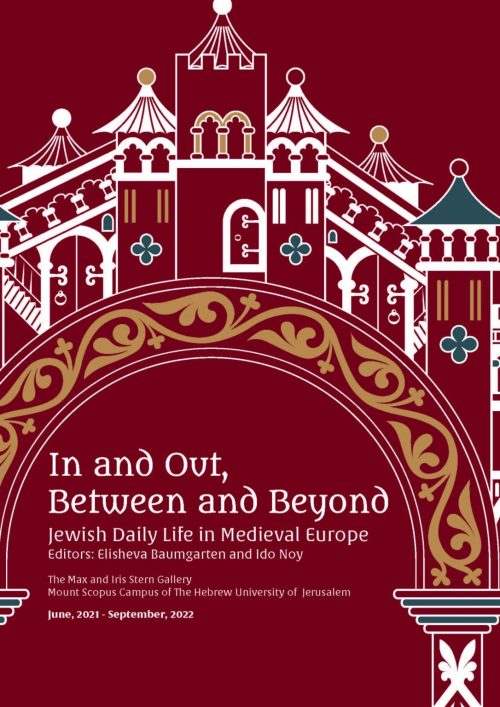
For more information on the project, see here. This book, produced for the exhibition In and Out, Between and Beyond, presents the scholarly work of a group of historians who study the Jews of medieval Ashkenaz at the Hebrew University of Jerusalem, in dialogue with the work of contemporary Israeli artists. This is one of the culminating projects of the European Research Council-funded research group Beyond the Elite: Jewish Daily Life in Medieval Europe. Since the inception of the project (fall 2016), the team has worked to construct a history which includes those who were not part of the learned elite as well as those who were learned, about whom we know more. The research team trained its sights on everyday moments, investigating daily routines and the ways medieval Jews understood their lives amidst their host cultures. At the heart of this work is the complexity of the circumstances in which medieval Jews lived: the integration of Ashkenazic Jews within their Christian surroundings, alongside their maintenance of a distinct religious identity. To complement the medieval study underlying this endeavor, the exhibit’s curator, Dr. Ido Noy, orchestrated a fruitful exchange between the research team and seven Israeli artists, who then produced contemporary expressions of the historic ideas under discussion. This book, mirroring the structure of the exhibit, is comprised of sixteen articles. Each one is built around a primary source from a particular literary genre. The colorful catalogue at the end of the volume documents the objects created especially for the exhibition that was displayed physically at the gallery on the Mount Scopus campus of The Hebrew University of Jerusalem and can still be viewed virtually.
-
Meir of Rothenburg (c. 1215 – 2 May 1293) was a German Rabbi and poet, a major author of the tosafot on Rashi’s commentary on the Talmud. He is also known as Meir ben Baruch, the Maharam of Rothenburg. His responsa are of great importance to advanced students of the Talmud, as well as to students of Jewish life and customs of the 13th Century.