-
The Addenda to Minhat Shai complete the publication of Minhat Shaion the Torah by Yedidyah Shlomo Norzi.
-
Minhat Shai, by the seventeenth-century scholar Yedidyah Shlomo Norzi, deals with the forms, vocalization, and Masoretic interpretation of biblical terms, in the order of their appearance in the Bible. The aim of this work is to analyze words with respect to their orthography, vocalization, and cantillation, and to assess their proper forms. The work was first printed in Mantua in the middle of the eighteenth century; it has since been reprinted in various places and always as part of editions of the Pentateuch or other sections of the Bible. The version in use today accords with the text as printed in Mikra’ot Gedolot (Vilna/Warsaw editions), where the relevant sections were appended following each biblical book. Even today, the work is considered an important guide as far as the biblical text is concerned; it reflects important decisions on questions of biblical orthography and interpretation. Scholars and students refer to it and respect its verdicts even though the version currently in use contains numerous errata. Many of the vocalization and cantillation marks noted by the author have been altered or omitted; thus, the author’s arguments are at times unclear, and at times even seem to contradict what may have been his original intention.
-
Sale!Minhat Shai, by the seventeenth-century scholar Yedidyah Shlomo Norzi, deals with the forms, vocalization, and Masoretic interpretation of biblical terms, in the order of their appearance in the Bible. The aim of this work is to analyze words with respect to their orthography, vocalization, and cantillation, and to assess their proper forms. The work was first printed in Mantua in the middle of the eighteenth century; it has since been reprinted in various places and always as part of editions of the Pentateuch or other sections of the Bible. The version in use today accords with the text as printed in Mikra’ot Gedolot (Vilna/Warsaw editions), where the relevant sections were appended following each biblical book. The Addenda to Minhat Shai complete the publication of Minhat Shai on the Torah.
-
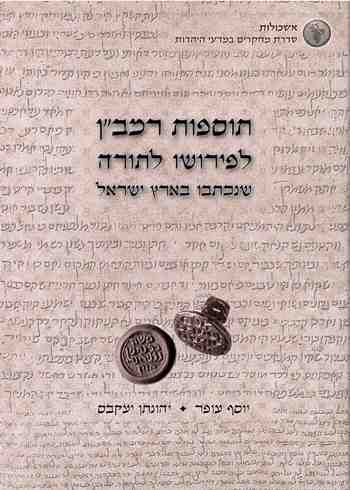
This book presents three hundred pieces added by Rabbi Moshe ben Nachman (Nachmanides) to his commentary on the Torah when he made Aliyah to Israel at the end of his life. The added segments were identified according to update lists sent by Nachmanides himself and others to the Diaspora, as well as on the basis of extensive comparative examination of all the hand-written transcripts of Nachmanides' interpretation of the Torah found today in the world (about fifty in number). There is a comprehensive introduction at the beginning of the book, that discusses the phenomenon of the additions and analyzes the findings of the hand-written transcripts and surveys the reasons and for these additional pieces. The bulk of the book is comprised of interpretive discussions detailed in every piece; whose purpose is to clarify Nachmanides' motives when making additions to what he first wrote. In the book itself – and the website that accompanies it – detailed information is presented about the additions and the evidence of them in the list of additions and the hand-written transcripts. The awareness of the commentary's formation by those who studied the commentary, both at large and specifically for each particular piece, adds a new dimension to the commentary, and is a significant contribution to understanding the way of Nachmanides, to solving problems in his sayings and clarifying his intent. To this end, the book is a very important tool for scholars of Nachmanides, Torah learners and lovers.
-
Table of contents can be found in this link.
-
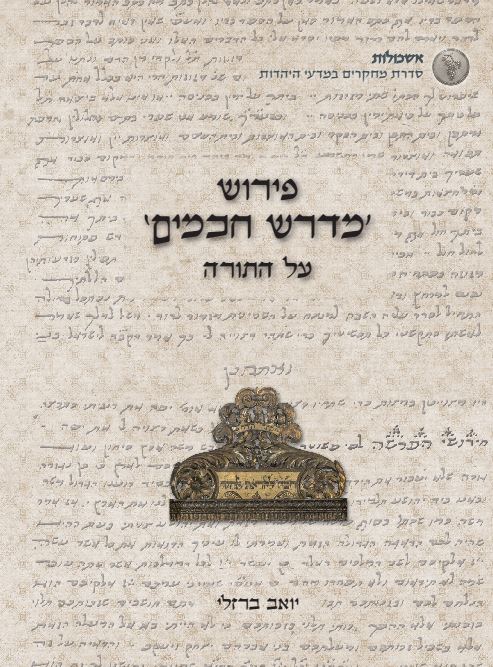
The commentaries of Midrash Chachamim were written by an anonymous Italian author in the early sixteenth century as part of an extensive commentary to the weekly portions of the Torah reading. Throughout the work, the author copied the early complete midrashim such as Genesis Rabba and the halakhic midrashim almost verbatim. His autonomous creation is contained mostly in the commentaries to those portions that are missing in the halakhic midrash, and as such they are contained in the books of Exodus, Numbers and Deuteronomy (though not for all portions of these books). The author tried to explain the verses according to their plain meaning, although he often incorporated in-depth discussions as well as interpretive and pedagogic excursus. In this edition, for the first time, the commentaries of Midrash Chachamim were collated from manuscript for the 27 weekly portions for which they were written, and brought together in order to present the author’s hermeneutical approach. The edition is complemented with an introduction that shows the background for writing these commentaries and discusses the style and interpretive techniques employed by the author.
-
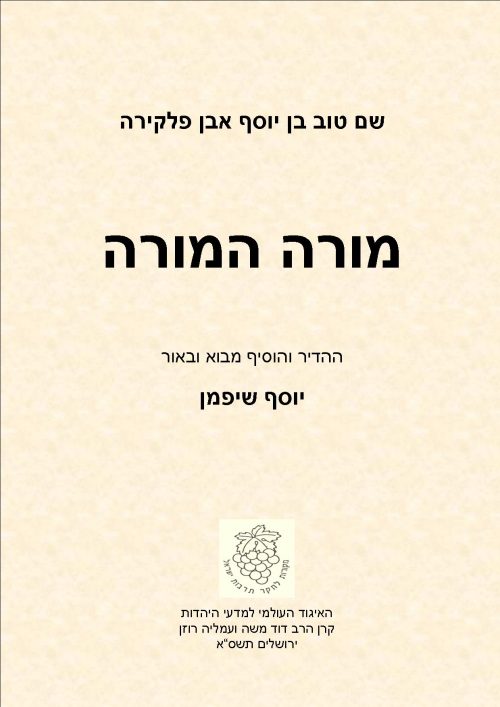
Out of stockMoreh Ha-moreh (The Guide’s Guide), by Shem-Tob ibn Falaquera, is one of the earliest commentaries on Maimonides’s Guide of the Perplexed. Falaquera’s knowledge of Arabic literature was broad, and he commented extensively on the well-known translation of the Guide by R. Samuel ibn Tibon. Given this knowledge, Falaquera was also acquainted with the philosophical sources behind Maimonides’ work, and referred to these in his own commentary. This critical edition of Falaquera’s work is based on all extant manuscripts known to us today; and it will be of value to all who wish to understand this important commentary and recover Maimonides’s sources. This edition presents the text of the Guide’s Guide, including varia lectionis and a commentary on Falaquera’s sources. These sources, which are largely also the sources of Maimonides, are discussed in great detail in the introduction to this edition.
-
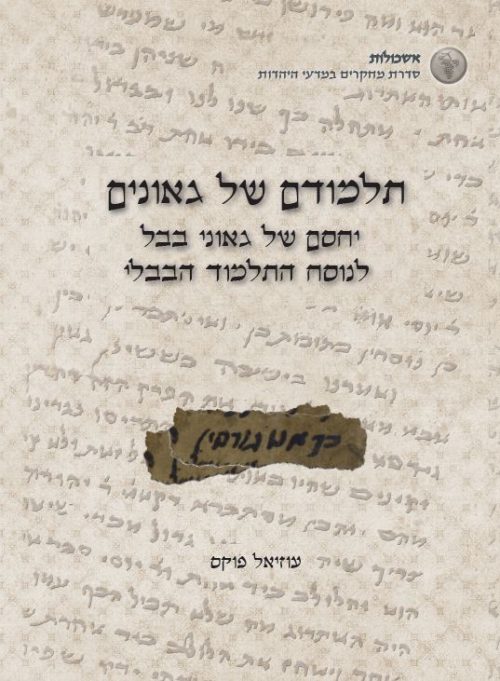
The Babylonian Talmud is the fundamental work of the Oral Law, both by virtue of the widespread and intensive study of it, and by virtue of reliance on it in halakhic writings, for over a thousand years. The Talmud gained much of its importance during the Geonic period. Throughout this time its transmission shifted from oral recitation to written copies, its text became standardized, and it was sent out from the Babylonian academies across the Jewish diaspora. Its intensive study and complex system of transmission both orally and in writing resulted in many variant readings between extant copies. This book deals with questions concerning the ways in which the Babylonian Talmud became such as seminal work, and especially the Geonate’s treatment of the its textual tradition: the ways in which the Geonim related to the variant readings, how they chose between them, and according to what criteria; to what extent were its early readings preserved and to what extent was its text altered. In the second half of the book the entire corpus in which the Geonim deal with Talmudic variants is presented and discussed.
-
Meir of Rothenburg (c. 1215 – 2 May 1293) was a German Rabbi and poet, a major author of the tosafot on Rashi’s commentary on the Talmud. He is also known as Meir ben Baruch, the Maharam of Rothenburg. His responsa are of great importance to advanced students of the Talmud, as well as to students of Jewish life and customs of the 13th Century.
-
Meir of Rothenburg (c. 1215 – 2 May 1293) was a German Rabbi and poet, a major author of the tosafot on Rashi’s commentary on the Talmud. He is also known as Meir ben Baruch, the Maharam of Rothenburg. His responsa are of great importance to advanced students of the Talmud, as well as to students of Jewish life and customs of the 13th Century.
-
Sale!Meir of Rothenburg (c. 1215 – 2 May 1293) was a German Rabbi and poet, a major author of the tosafot on Rashi's commentary on the Talmud. He is also known as Meir ben Baruch, the Maharam of Rothenburg. His responsa are of great importance to advanced students of the Talmud, as well as to students of Jewish life and customs of the 13th Century.
-
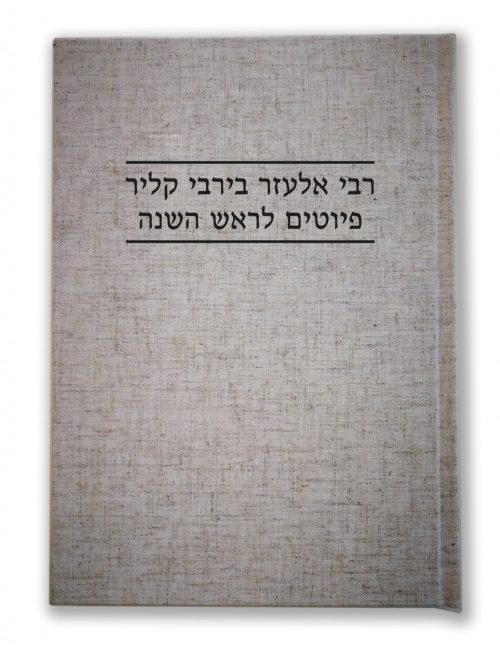
Sale!Rabbi El’azar Berabbi Qillir (commonly known as “HaQallir”) was the most famous and productive of the Hebrew poets during the peak era of early Hebrew piyyut (liturgical poetry) between the sixth and eighth centuries AD. Of the thousands of poems he penned, some were preserved in the Asheknazi, French and Italian mahzorim (prayer books) for the High Holy Days, and a few of them are recited in synagogues to this day.