-
Out of stockMoreh Ha-moreh (The Guide’s Guide), by Shem-Tob ibn Falaquera, is one of the earliest commentaries on Maimonides’s Guide of the Perplexed. Falaquera’s knowledge of Arabic literature was broad, and he commented extensively on the well-known translation of the Guide by R. Samuel ibn Tibon. Given this knowledge, Falaquera was also acquainted with the philosophical sources behind Maimonides’ work, and referred to these in his own commentary. This critical edition of Falaquera’s work is based on all extant manuscripts known to us today; and it will be of value to all who wish to understand this important commentary and recover Maimonides’s sources. This edition presents the text of the Guide’s Guide, including varia lectionis and a commentary on Falaquera’s sources. These sources, which are largely also the sources of Maimonides, are discussed in great detail in the introduction to this edition.
-
This book presents three hundred pieces added by Rabbi Moshe ben Nachman (Nachmanides) to his commentary on the Torah when he made Aliyah to Israel at the end of his life. The added segments were identified according to update lists sent by Nachmanides himself and others to the Diaspora, as well as on the basis of extensive comparative examination of all the hand-written transcripts of Nachmanides' interpretation of the Torah found today in the world (about fifty in number). There is a comprehensive introduction at the beginning of the book, that discusses the phenomenon of the additions and analyzes the findings of the hand-written transcripts and surveys the reasons and for these additional pieces. The bulk of the book is comprised of interpretive discussions detailed in every piece; whose purpose is to clarify Nachmanides' motives when making additions to what he first wrote. In the book itself – and the website that accompanies it – detailed information is presented about the additions and the evidence of them in the list of additions and the hand-written transcripts. The awareness of the commentary's formation by those who studied the commentary, both at large and specifically for each particular piece, adds a new dimension to the commentary, and is a significant contribution to understanding the way of Nachmanides, to solving problems in his sayings and clarifying his intent. To this end, the book is a very important tool for scholars of Nachmanides, Torah learners and lovers.
-
The commentaries of Midrash Chachamim were written by an anonymous Italian author in the early sixteenth century as part of an extensive commentary to the weekly portions of the Torah reading. Throughout the work, the author copied the early complete midrashim such as Genesis Rabba and the halakhic midrashim almost verbatim. His autonomous creation is contained mostly in the commentaries to those portions that are missing in the halakhic midrash, and as such they are contained in the books of Exodus, Numbers and Deuteronomy (though not for all portions of these books). The author tried to explain the verses according to their plain meaning, although he often incorporated in-depth discussions as well as interpretive and pedagogic excursus. In this edition, for the first time, the commentaries of Midrash Chachamim were collated from manuscript for the 27 weekly portions for which they were written, and brought together in order to present the author’s hermeneutical approach. The edition is complemented with an introduction that shows the background for writing these commentaries and discusses the style and interpretive techniques employed by the author.
-
The Babylonian Talmud is the fundamental work of the Oral Law, both by virtue of the widespread and intensive study of it, and by virtue of reliance on it in halakhic writings, for over a thousand years. The Talmud gained much of its importance during the Geonic period. Throughout this time its transmission shifted from oral recitation to written copies, its text became standardized, and it was sent out from the Babylonian academies across the Jewish diaspora. Its intensive study and complex system of transmission both orally and in writing resulted in many variant readings between extant copies. This book deals with questions concerning the ways in which the Babylonian Talmud became such as seminal work, and especially the Geonate’s treatment of the its textual tradition: the ways in which the Geonim related to the variant readings, how they chose between them, and according to what criteria; to what extent were its early readings preserved and to what extent was its text altered. In the second half of the book the entire corpus in which the Geonim deal with Talmudic variants is presented and discussed.
-
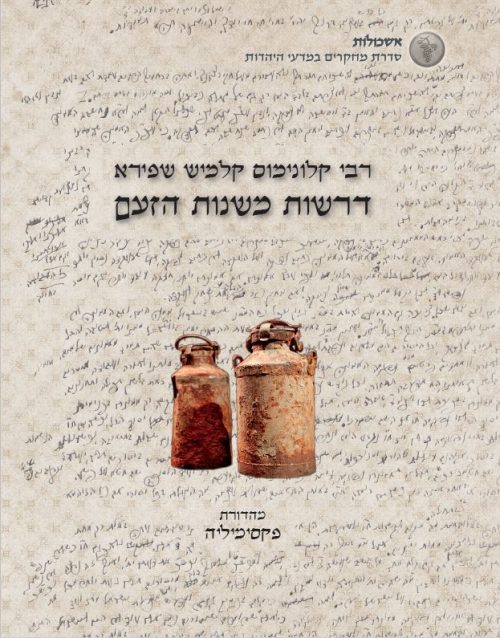
Sale!Facsimile Edition This book presents the sermons of Rabbi Kalonymus Kalmish Shapira, The Piaseczno Rebbe, which were delivered during the Holocaust years in the Warsaw Ghetto. The second volume is a facsimile edition, with the original manuscript on one side and the detailed line-by-line presentation of the text as the Rebbe corrected it. The second volume includes the words and passages that were deleted and is printed in 4 different colors which follow the proofs and changes that the Rebbe made in the text.
-
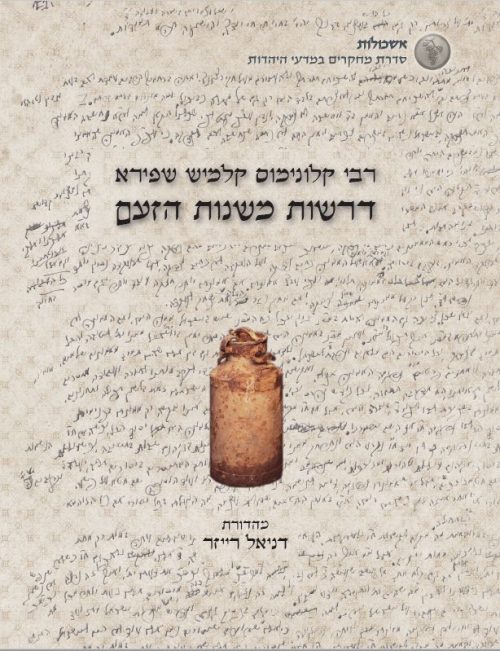
Scholarly Edition This book presents the sermons of Rabbi Kalonymus Kalmish Shapira, The Piaseczno Rebbe, which were delivered during the Holocaust years in the Warsaw Ghetto. The second volume is a facsimile edition, with the original manuscript on one side and the detailed line-by-line presentation of the text as the Rebbe corrected it. The second volume includes the words and passages that were deleted and is printed in 4 different colors which follow the proofs and changes that the Rebbe made in the text.
-
Samuel b. Judah ibn Tibbon (c. 1165-1232) is most famous for his translation of Maimonides’ Guide of the Perplexed into Hebrew. He translated other writings as well, and produced original works of philosophy and biblical exegesis. This book makes available for the first time ever Ibn Tibbon’s Perush Qohelet, a sprawling adaptation of Maimonides’ method of exegesis to the complete verse-by-verse explication of a biblical book. The edition is presented with full annotation -- identifying Ibn Tibbon’s sources and explaining his ideas and terminology -- and analytical introduction, which presents the life and writings of the author, describes the commentary itself in detail, explains the method and philosophy of the commentary, and charts its historical influence. In later medieval Jewish thought, few figures were unaffected by this foundational work of Maimonideanism.
-
Critical annotated edition of part one of treatise seven of R. Levi's encyclopedia, which is devoted to an exegesis of the "Work of the Chariot". This volume also contains an edition of the surviving section of treatise five of the encyclopedia ("Divine Science") and a critical edition of the section of the poem "Battei ha-Nefesh ve-ha-Laḥashim" devoted to the "Work of the Chariot", together with the four medieval commentaries written on this section. The introduction to this volume discusses at length the interpretation of the "Work of the Chariot" from rabbinic times to R. Levi. Towards the end of the thirteenth century, the Provençal Jewish philosopher R. Levi ben Avraham wrote a unique treatise – an in-depth Hebrew encyclopedia of the sciences and of Judaism entitled Livyat Ḥen. R. Levi was known already in his lifetime as a leading exponent of the philosophical-allegorical interpretation of the Torah and of rabbinic midrash. In the Jewish part of his encyclopedia he deals with a myriad of topics, including Jewish ethics, prophecy, the reasons for the commandments, the stories of Moses and the patriarchs, the principles of faith, the Work of Creation, the Work of the Chariot, and the interpretation of rabbinic midrash and aggadah. Prior to Livyat Ḥen R. Levi wrote an encyclopedic poem of over 1000 stanzas in rhymed meter entitled Batei ha-Nephesh ve-ha-Laḥashim. This poem is devoted to the same topics in science and Judaism that are later discussed in great detail in his treatise.
-
The book Ahava ba-Taanugim (Love In delights) was written during the years 1353 – 1356 by Rabbi Moses Ben Judah. It is a huge and comprehensive encyclopedia of Aristotelian physics and metaphysics and includes also a substantial theological section. Its author discusses and explains each scientific topic in a creative and innovative way: Some explanations on matter, atoms, time and motion, have no source in the classical Aristotelian literature. These innovations contributed to the development of sciences of the author's days and they reflect new trends of the study of Aristotle's philosophy of nature among the 14th century scholars. These trends paved the ground for modern science that, as modern scholarship observed, did not emerge ex nihilo, but had its roots in the criticism of Aristotelian science in the 14th century. The current book is a critical edition of the first seven discourses of the first part of the encyclopedia, which deals with physics. Each discourse deals with one scientific topic and includes some biblical commentarial chapters that aim to show the harmony between the scientific topic and the Torah and to expose the secrets that were hinted by Ibn Ezra, Maimonides and Nachmanides in their treatises. The edition includes an introduction which presents a general overview of the treatise: its period, place and its purpose, its sources and its approach. The introduction also describes and explains the content of the seven discourses presented in the edition and highlights its innovations and main original explanations. This book is in Hebrew edition only.
-
This book represents a first attempt to assemble liturgical poems in a scientific edition according to their genre rather than according to authorship. All the Shiv‛atot cycles (liturgical poems for shabbat Amidah prayer) composed according to the order of the weekly Torah portion have been collected from the Genizah manuscripts. The book presents three main cycles, representing three stages in the history of liturgical poems: The remnants of an ancient Shiv‛atot cycle (composed around the sixth century) which was dedicated to the reading order of the Eretz-Israel triennial cycle, and two Shiv‛atot cycles for the annual cycle’s tractates – one of which was probably composed around the ninth or tenth century and remains loyal to the classical traditions of the genre, and the second, probably composed at the end of the tenth century or the beginning of the eleventh, which reflects a stage in which the later poets abandoned the ancient patterns or restricted them. Alongside these cycles, sections of other Shiv‛atot cycles whose remnants were found in the Genizah are included. The poems are printed in their entirety, with variant manuscripts readings and detailed notes. The book opens with an introduction that describes each cycle in detail and examines the development of the genre over the generations.
-
For over fourteen hundred years, since post-Talmudic times, a list of fast days has been in circulation; it mandates at least one, but occasionally two, three, and even four fasts per month. These fasts commemorate disasters that occurred during biblical and Second Temple times; events connected with the Temple’s destruction; and the deaths of well-known individuals. The list penetrated into central halachic works; in some circles these events are commemorated to this day, albeit not by fasting. This list is known as Megillat Taʿanit Batra, “the later scroll of fasts,” to distinguish it from Megillat Taʿanit, which originated in the Second Temple period. This book traces the historical development of the list. The author has culled previously unknown versions of this list from manuscripts, early piyyutim, and other surprising sources. All these versions of the list are discussed in detail; a synoptic analysis of each fast, as presented in the various sources, attempts to solve some of the riddles presented by the texts. Towards the end of the book, a detailed chapter deals with the complex occurrences of the list in halachic literature. The final chapter sets out the internal structure of the list; attempts to arrive at its original form; and maps its metamorphoses through time.
-
This book presents Piyyutim (liturgical poetry) written by one of the most important poets in the Land of Israel, Rabbi Pinhas Hacohen birabi Yaacov, who lived in the area of Tiberias in the 8th century. The Piyyutim are taken from manuscripts of the Cairo Genizah, and are published for the first time. R' Pinhas seals the classic period of early Paytanim (authors of liturgical poetry) in the Land of Israel. His work preserves the variety of genres typical for classic Piyyutim, yet shows early signs of developments characteristic to late Eastern liturgical poetry. R. Pinhas' Piyyutim reveal a great poet with impressive compositional durability. In some of them he reaches unique climaxes, especially through dramatic developments in the Piyut.