
Meir of Rothenburg (c. 1215 – 2 May 1293) was a German Rabbi and poet, a major author of the tosafot on Rashi’s commentary on the Talmud. He is also known as Meir ben Baruch, the Maharam of Rothenburg. His responsa are of great importance to advanced students of the Talmud, as well as to students of Jewish life and customs of the 13th Century.
-
The Addenda to Minhat Shai complete the publication of Minhat Shaion the Torah by Yedidyah Shlomo Norzi.
-
Sale!Minhat Shai, by the seventeenth-century scholar Yedidyah Shlomo Norzi, deals with the forms, vocalization, and Masoretic interpretation of biblical terms, in the order of their appearance in the Bible. The aim of this work is to analyze words with respect to their orthography, vocalization, and cantillation, and to assess their proper forms. The work was first printed in Mantua in the middle of the eighteenth century; it has since been reprinted in various places and always as part of editions of the Pentateuch or other sections of the Bible. The version in use today accords with the text as printed in Mikra’ot Gedolot (Vilna/Warsaw editions), where the relevant sections were appended following each biblical book. The Addenda to Minhat Shai complete the publication of Minhat Shai on the Torah.
-
Table of contents can be found in this link.
-
Jewish Studies 57 (1) (2022) Table of Contents Abstracts List of Articles: Maya Shemuelli- An Existential View of Return and Alienation: Exegetic Examination of the Book of Ruth Ofer Elior- The Medieval Hebrew Translations of Euclid's Elements Judith Weiss- Dehiyya, Halifa, and HIbbur: Sefirotic Notions of Metempsychosis in Early Kabbalistic Literature and Some of their Reverberations Ayelet Walfish-Fraenkel- Angels, Demons, and Warlocks: The Myth of the Sons of God and the Daughters of Men in the Zohar as an Etiology of Evil Neta Dan- “22 Letters for Cursing”: Swearing and Insults in Uri Zvi Greenberg's Poetic Language
-
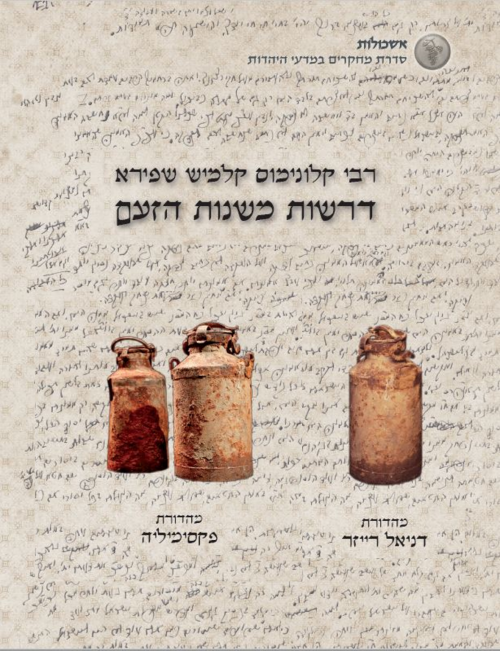
Sale!Scholarly and Facsimile Edition This book presents the sermons of Rabbi Kalonymus Kalmish Shapira, The Piaseczno Rebbe, which were delivered during the Holocaust years in the Warsaw Ghetto. The second volume is a facsimile edition, with the original manuscript on one side and the detailed line-by-line presentation of the text as the Rebbe corrected it. The second volume includes the words and passages that were deleted and is printed in 4 different colors which follow the proofs and changes that the Rebbe made in the text.
-
Jewish Studies 57 (2) (2022) Table of Contents Abstracts List of Articles: Noam Mizrahi - The Interpretive Transmission of Isaiah as Witnessed by 4QIsag (4Q61) Yael Escojido and Emmanuel Friedheim - The Liberation of Jewish Slaves in the Letter of Aristeas as an Expression of Fear of Assimilation: A Study of the Assimilation Process Affecting Jewish Slaves in the Hellenistic Diaspora Hananel Mack - Because of Whom do the Rains Fall? Alternating Credits in Rain Stories of the Aggadah Literature Gilad Sasson - “In the Sanctuary, O Lord, which thy Hands have Established”: The Homily of Mekhilta of R. Ishmael and Its Parallels in Avot de-Rabbi Natan and in Bavli Ketubbot