-
The book Ahava ba-Taanugim (Love In delights) was written during the years 1353 – 1356 by Rabbi Moses Ben Judah. It is a huge and comprehensive encyclopedia of Aristotelian physics and metaphysics and includes also a substantial theological section. Its author discusses and explains each scientific topic in a creative and innovative way: Some explanations on matter, atoms, time and motion, have no source in the classical Aristotelian literature. These innovations contributed to the development of sciences of the author's days and they reflect new trends of the study of Aristotle's philosophy of nature among the 14th century scholars. These trends paved the ground for modern science that, as modern scholarship observed, did not emerge ex nihilo, but had its roots in the criticism of Aristotelian science in the 14th century. The current book is a critical edition of the first seven discourses of the first part of the encyclopedia, which deals with physics. Each discourse deals with one scientific topic and includes some biblical commentarial chapters that aim to show the harmony between the scientific topic and the Torah and to expose the secrets that were hinted by Ibn Ezra, Maimonides and Nachmanides in their treatises. The edition includes an introduction which presents a general overview of the treatise: its period, place and its purpose, its sources and its approach. The introduction also describes and explains the content of the seven discourses presented in the edition and highlights its innovations and main original explanations. This book is in Hebrew edition only.
-
55 Geniza Documents.
-
Critical annotated edition of the third part of treatise six of R. Levi's encyclopedia, which is devoted to an exegesis of the "Work of Creation". In this part R. Levi deals with the creation story in the Torah, the story of Adam and Eve in the Garden of Eden, and the stories of the early generations of humanity. The edition includes both the shorter and longer recensions of this part, as well as a critical edition of the section "Work of Creation" in R. Levi's encyclopedic poem, "Battei ha-Nefesh ve-ha-Laḥashim", together with the four medieval commentaries written on this section. The introduction to this volume discusses the author and his works and deals with the historical background to R. Levi's approach to the "Work of Creation".
-
Critical annotated edition of part one of treatise seven of R. Levi's encyclopedia, which is devoted to an exegesis of the "Work of the Chariot". This volume also contains an edition of the surviving section of treatise five of the encyclopedia ("Divine Science") and a critical edition of the section of the poem "Battei ha-Nefesh ve-ha-Laḥashim" devoted to the "Work of the Chariot", together with the four medieval commentaries written on this section. The introduction to this volume discusses at length the interpretation of the "Work of the Chariot" from rabbinic times to R. Levi. Towards the end of the thirteenth century, the Provençal Jewish philosopher R. Levi ben Avraham wrote a unique treatise – an in-depth Hebrew encyclopedia of the sciences and of Judaism entitled Livyat Ḥen. R. Levi was known already in his lifetime as a leading exponent of the philosophical-allegorical interpretation of the Torah and of rabbinic midrash. In the Jewish part of his encyclopedia he deals with a myriad of topics, including Jewish ethics, prophecy, the reasons for the commandments, the stories of Moses and the patriarchs, the principles of faith, the Work of Creation, the Work of the Chariot, and the interpretation of rabbinic midrash and aggadah. Prior to Livyat Ḥen R. Levi wrote an encyclopedic poem of over 1000 stanzas in rhymed meter entitled Batei ha-Nephesh ve-ha-Laḥashim. This poem is devoted to the same topics in science and Judaism that are later discussed in great detail in his treatise.
-
Sale!Jewish Studies 56 (2021) Full Table of Contents Abstracts List of Articles: HEBREW SECTION Yuval Fraenkel - Between Man and Place: The Holy Man and the Temple in Stories about Ḥoni Ha`meagel, and R. Ḥanina Ben Dosa Yosef Marcus - The Status of Persons with Physical Defects in Tannaitic Literature: A New Analysis Michael Avioz - “It is Known that the Stag eats Snakes”: Examining the Scientific Knowledge Drawn Upon by Medieval Jewish Interpretations of Psalms 42 Abraham David - Flavius Josephus’s Writings in Sixteenth Century Jewish Historiography: The Case of Shalshelet ha-Kabbalah of Gedalyah Ibn Yaḥya Chen Avizohar-Hagay and Yuval Harari - ‘For a Woman in a Hard Labor’: A Compilation of Magic Recipes to Deal with Labor Difficulties Ben Landau Spinoza and the “Ecole de Paris” 161 ENGLISH SECTION Israel Knohl - The Original Version of the Priestly Creation Account and the Religious Significance of the Number Eight in the Bible and in Early Jewish MysticismIn his influential study on Jewish mysticism, Gershom
-
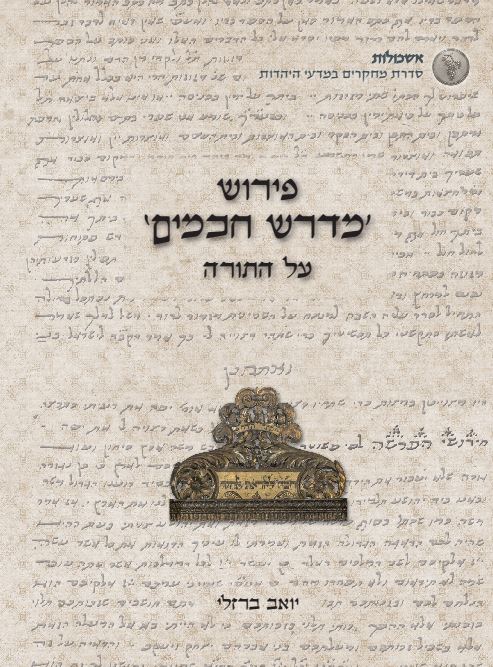
The commentaries of Midrash Chachamim were written by an anonymous Italian author in the early sixteenth century as part of an extensive commentary to the weekly portions of the Torah reading. Throughout the work, the author copied the early complete midrashim such as Genesis Rabba and the halakhic midrashim almost verbatim. His autonomous creation is contained mostly in the commentaries to those portions that are missing in the halakhic midrash, and as such they are contained in the books of Exodus, Numbers and Deuteronomy (though not for all portions of these books). The author tried to explain the verses according to their plain meaning, although he often incorporated in-depth discussions as well as interpretive and pedagogic excursus. In this edition, for the first time, the commentaries of Midrash Chachamim were collated from manuscript for the 27 weekly portions for which they were written, and brought together in order to present the author’s hermeneutical approach. The edition is complemented with an introduction that shows the background for writing these commentaries and discusses the style and interpretive techniques employed by the author.
-
Jewish Studies 57 (2) (2022) Table of Contents Abstracts List of Articles: Noam Mizrahi - The Interpretive Transmission of Isaiah as Witnessed by 4QIsag (4Q61) Yael Escojido and Emmanuel Friedheim - The Liberation of Jewish Slaves in the Letter of Aristeas as an Expression of Fear of Assimilation: A Study of the Assimilation Process Affecting Jewish Slaves in the Hellenistic Diaspora Hananel Mack - Because of Whom do the Rains Fall? Alternating Credits in Rain Stories of the Aggadah Literature Gilad Sasson - “In the Sanctuary, O Lord, which thy Hands have Established”: The Homily of Mekhilta of R. Ishmael and Its Parallels in Avot de-Rabbi Natan and in Bavli Ketubbot
-
Jewish Studies 57 (1) (2022) Table of Contents Abstracts List of Articles: Maya Shemuelli- An Existential View of Return and Alienation: Exegetic Examination of the Book of Ruth Ofer Elior- The Medieval Hebrew Translations of Euclid's Elements Judith Weiss- Dehiyya, Halifa, and HIbbur: Sefirotic Notions of Metempsychosis in Early Kabbalistic Literature and Some of their Reverberations Ayelet Walfish-Fraenkel- Angels, Demons, and Warlocks: The Myth of the Sons of God and the Daughters of Men in the Zohar as an Etiology of Evil Neta Dan- “22 Letters for Cursing”: Swearing and Insults in Uri Zvi Greenberg's Poetic Language
-
Table of contents can be found in this link.
-
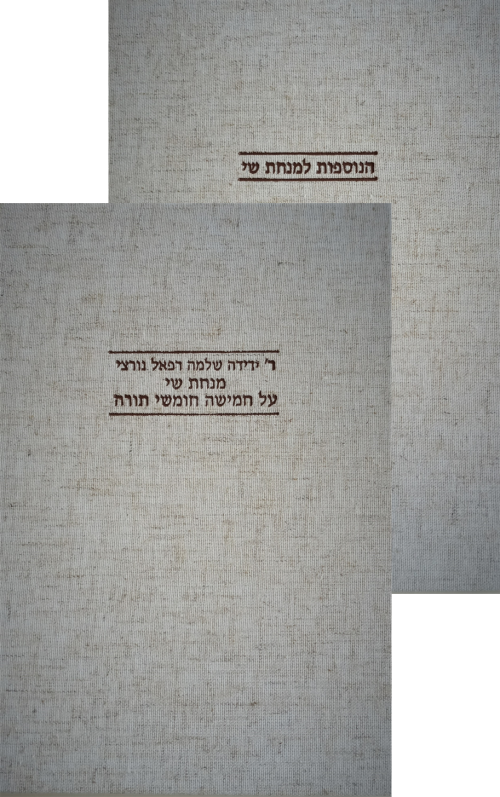
Sale!Minhat Shai, by the seventeenth-century scholar Yedidyah Shlomo Norzi, deals with the forms, vocalization, and Masoretic interpretation of biblical terms, in the order of their appearance in the Bible. The aim of this work is to analyze words with respect to their orthography, vocalization, and cantillation, and to assess their proper forms. The work was first printed in Mantua in the middle of the eighteenth century; it has since been reprinted in various places and always as part of editions of the Pentateuch or other sections of the Bible. The version in use today accords with the text as printed in Mikra’ot Gedolot (Vilna/Warsaw editions), where the relevant sections were appended following each biblical book. The Addenda to Minhat Shai complete the publication of Minhat Shai on the Torah.